Categories
BOOK REVIEWS

The Hard Thing About Hard Things Review and Summary

A Hard Thing About Hard Things review and summary: Ben Horowitz on the brutal realities of building and running a company that no one prepares you for.
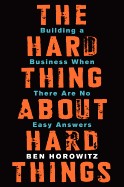
The Hard Thing About Hard Things by Ben Horowitz book cover

★★★★½4.6/5

The verdict: Honest about the mess of running something, which most business books are not.

🎧 Listen free on Audible
Try Kindle Unlimited
Buy the paperback

⚡ Quick answerThe Hard Thing About Hard Things by Ben Horowitz gets 4.6/5 from me. Honest about the mess of running something, which most business books are not. Anyone carrying the weight of a business who wants honest company rather than tidy theory.

What is The Hard Thing About Hard Things about?

Horowitz, a founder turned venture capitalist, writes candidly about the hardest parts of running a business, the decisions, crises and lonely calls that the usual success stories skip over entirely.

The Hard Thing About Hard Things summary

Horowitz sets out to write the book he wishes he had had: not the tidy success story, but an honest account of the brutal, uncertain parts of running a company that most business books ignore. Drawing on his own turbulent experience building and nearly losing companies, he covers the hard things there is no formula for.

He writes frankly about making decisions with incomplete information, managing your own psychology when everything is falling apart, laying people off and demoting friends, firing executives, and the loneliness of being the one who has to make the final call. He is candid about how close his own companies came to failure, and about the gap between the theory of management and the messy reality. Along the way he shares hard-won lessons on hiring, company culture, and leading through crises, delivered bluntly and without the usual gloss.

It is more memoir and reflection than step-by-step manual, and it is pitched at people running venture-backed companies. But the honesty about the emotional and practical difficulty of leadership is rare and valuable, and it translates to anyone carrying the weight of a business.

Published in 2014 by a prominent founder turned venture capitalist, it became a favourite among entrepreneurs for its unusual candour. It is aimed at people building and running companies who want honesty about how hard it really is.

The one idea worth the price: There are no easy formulas for the hardest calls; the job is to keep making decisions and keep going when there is no clear right answer.

Key ideas and takeaways

  • There is no recipe. The hardest problems have no formula; you decide and live with it.
  • Manage your own head. Leading through crisis means managing your own psychology first.
  • The struggle. Every founder faces the grind where it might all fall apart.
  • Honest leadership. Tell hard truths, make hard calls, and own them.

My honest take

Most business books tell you how it should go. This one tells you how it actually feels when it is going wrong, and that honesty is exactly what makes it valuable. Horowitz does not pretend there is a neat formula for the hardest decisions, because there is not, and saying so plainly is more useful than another tidy framework.

The scale is different for most of us, few readers here are running venture-backed firms on the brink, but the emotional truth carries. The loneliness of the final call, making decisions without enough information, keeping going when it might all collapse: any self-employed person who has lain awake over their business will recognise it. It is oddly reassuring to hear someone successful admit how hard and uncertain it really is. Read it for the honesty and the perspective, not for a checklist.

Because it is drawn from the high-stakes world of funded startups, some of the specifics, firing executives, board battles, will not map onto a solo business. But the underlying message, that leadership is mostly about handling hard things without a map, is universal.

The honest caveat: It is pitched at venture-backed company leaders, so a lot of the specific scenarios will not apply to a solo operator. Read it for the emotional honesty and perspective rather than directly transferable tactics.

Where it falls short

  • Aimed at funded-startup leaders, so many specifics do not fit a one-person business.
  • More candid memoir than practical manual, so those wanting step-by-step guidance will not find it.

How it compares

Good to Great researches what makes companies succeed; The Hard Thing About Hard Things tells you honestly how it feels to run one when it might fail. Read Collins for the patterns and Horowitz for the reality.

Who should read it (and who should skip it)

Anyone carrying the weight of a business who wants honest company rather than tidy theory. Skip it if you want a practical how-to or are very early in your journey.

Best format: Audio or Kindle; it reads like Horowitz talking, which suits listening.

How to actually use it if you are self-employed

  • When facing a hard call with no clear answer, accept there is no formula and decide anyway.
  • Look after your own head; you cannot lead well while running on empty.
  • Tell the hard truths in your business rather than avoiding them.
⚡ The 60-second recap

  • The hardest calls have no formula.
  • Managing your own psychology comes first.
  • Honesty about the struggle is the real value.
A book is a shortcut. A second pair of eyes is faster.

Twenty years self-employed, 500+ people coached. If you want help applying this to your own situation, book a free discovery call.

Book a free discovery call

Frequently asked questions

Is it a how-to book?

Not really. It is a candid memoir and reflection on the hardest parts of leadership, not a step-by-step manual.

Is it only for startup founders?

It is pitched at them, but the honesty about the emotional weight of running a business resonates more widely.

Why is it well regarded?

Because it is unusually honest about failure, difficulty and uncertainty, where most business books only show success.

Will it help a solo business?

Some specifics will not apply, but the perspective and honesty are valuable for anyone carrying a business.

Is it a positive or negative read?

It is honest about how hard things get, but many readers find that reassuring rather than discouraging.

Final verdict

The Hard Thing About Hard Things earns 4.6/5. Honest about the mess of running something, which most business books are not. If it is the stage you are at, the cheapest way in is a free Audible trial or Kindle Unlimited.

Disclosure: Some links in this article are affiliate links. If you buy through them I may earn a small commission, at no extra cost to you. Star ratings are my own editorial scores.
Categories
BOOK REVIEWS

Zero to One Review and Summary

A Zero to One review and summary: Peter Thiel on building something genuinely new instead of copying what already exists.

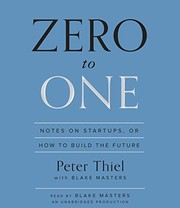
Zero to One by Peter Thiel & Blake Masters book cover

★★★★½4.5/5

The verdict: Contrarian, quotable, and a good corrective to me-too thinking.

🎧 Listen free on Audible
Try Kindle Unlimited
Buy the paperback

⚡ Quick answerZero to One by Peter Thiel & Blake Masters gets 4.5/5 from me. Contrarian, quotable, and a good corrective to me-too thinking. Anyone about to build a me-too business who needs pushing to find a distinctive angle.

What is Zero to One about?

Thiel argues that real progress and real value come from going from zero to one, creating something genuinely new, rather than from one to many, copying what already works. It is a book about building the future rather than competing in the present.

Zero to One summary

Based on Thiel's Stanford lectures and written up with Blake Masters, the book makes a contrarian case about innovation and business. Going from one to many, he says, is copying things that already exist; going from zero to one is creating something genuinely new, and that is where real value is made.

His most provocative argument is about competition. Most people assume competition is healthy, but Thiel argues that fierce competition destroys profit, and that the goal should be to build a monopoly, something so distinctive it has no real competitors, at least for a while. He explores how to do that: starting by dominating a small niche, building a genuine edge, thinking for yourself rather than following the crowd, and the surprising importance of sales and distribution even for great products. A recurring theme is his contrarian question: what important truth do very few people agree with you on.

It is short, dense and quotable, more a set of provocations about building the future than a step-by-step manual. Some of it is pitched at ambitious startups, but the core challenge, build something distinctive rather than another copy, applies more widely.

Published in 2014, based on Thiel's Stanford startup lectures, it became a widely read book on innovation and building companies. It is aimed at founders and ambitious builders, though its core ideas apply more broadly.

The one idea worth the price: Do not build a slightly better copy of what exists; build something new and distinctive enough that you are not really competing at all.

Key ideas and takeaways

  • Zero to one. Create something new rather than copying what works.
  • Competition is overrated. Fierce competition destroys profit; distinctiveness protects it.
  • Start with a niche. Dominate a small market before expanding.
  • Think for yourself. Ask what important truth few people agree with you on.

My honest take

This is a book to read when you are about to build another me-too version of something that already exists, which is what a lot of new businesses are. Thiel's central challenge, to create something genuinely distinctive rather than compete on being marginally better or cheaper, is a valuable corrective.

For the self-employed, the scale of Thiel's startup examples can feel remote, but the principle scales down. Being the obvious, distinctive choice in a small niche beats being one of twenty near-identical freelancers competing on price. His contrarian question, what do you believe that few others do, is a genuinely useful prompt for finding your own angle. It is quotable and thought-provoking, even where you disagree with him, and it is short enough to read in a couple of sittings.

Thiel is a divisive figure and some of his broader worldview will not sit well with every reader. Taken purely as a book about building something distinctive, though, it is sharp and worth the time, disagreements and all.

The honest caveat: The examples are pitched at venture-scale startups, which can feel remote from a solo business, and Thiel's wider views divide opinion. Take the principle of distinctiveness and scale it to your situation.

Where it falls short

  • Startup and venture-scale framing feels distant from a one-person business.
  • Some arguments are provocative for effect, and the author is a polarising figure.

How it compares

Where most business books help you compete better, Zero to One argues you should avoid competition by being distinctive. Pair it with Start with Why to turn that distinctiveness into a clear message.

Who should read it (and who should skip it)

Anyone about to build a me-too business who needs pushing to find a distinctive angle. Skip it if you want practical, small-business steps rather than big-picture provocation.

Best format: Kindle or paper; it is short and quotable, good to note the ideas.

How to actually use it if you are self-employed

  • Ask what makes your offer genuinely different, not just cheaper or slightly better.
  • Pick a small niche you could realistically dominate first.
  • Answer Thiel's question: what do you believe that few others do.
⚡ The 60-second recap

  • Build something new, not a copy.
  • Distinctiveness beats competition.
  • Start by owning a small niche.
A book is a shortcut. A second pair of eyes is faster.

Twenty years self-employed, 500+ people coached. If you want help applying this to your own situation, book a free discovery call.

Book a free discovery call

Frequently asked questions

What does zero to one mean?

Creating something genuinely new (zero to one) rather than copying what already exists (one to many).

Is it only for tech startups?

The examples are, but the core idea, build something distinctive rather than a copy, applies to any business.

What is the contrarian question?

What important truth do very few people agree with you on? Thiel uses it to find original ideas and opportunities.

Is it practical?

More provocation than step-by-step, though it will sharpen how you think about what you are building.

Is it a quick read?

Yes, it is short and quotable, readable in a couple of sittings.

Final verdict

Zero to One earns 4.5/5. Contrarian, quotable, and a good corrective to me-too thinking. If it is the stage you are at, the cheapest way in is a free Audible trial or Kindle Unlimited.

Disclosure: Some links in this article are affiliate links. If you buy through them I may earn a small commission, at no extra cost to you. Star ratings are my own editorial scores.
Categories
BOOK REVIEWS

The Lean Startup Review and Summary

A Lean Startup review and summary: translating Eric Ries' build-measure-learn discipline down to the scale of a one-person business.

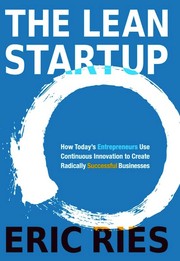
The Lean Startup by Eric Ries book cover

★★★★½4.5/5

The verdict: The book that stops you building something nobody wants.

🎧 Listen free on Audible
Try Kindle Unlimited
Buy the paperback

⚡ Quick answerThe Lean Startup by Eric Ries gets 4.5/5 from me. The book that stops you building something nobody wants. Anyone about to build or launch something.

What is The Lean Startup about?

Ries applies lean manufacturing thinking to startups: build a minimum viable product, measure how real customers respond, learn from it and iterate. The aim is validated learning instead of expensive guessing.

The Lean Startup summary

Ries built the method after watching startups pour years and fortunes into products nobody wanted. His fix borrows from lean manufacturing and reframes a startup as a machine for learning under extreme uncertainty, rather than a smaller version of a big company executing a known plan.

The core loop is build, measure, learn. You build the smallest possible version of your idea, the minimum viable product, put it in front of real customers, measure how they actually behave, and use what you learn to decide the next move. He is fierce about measuring the right things, drawing a sharp line between vanity metrics that flatter you and actionable metrics that tell you the truth.

The biggest strategic idea is pivot or persevere. At regular checkpoints you look honestly at the data and decide whether to keep going or change direction. Done well, it means you fail cheaply and early on the wrong ideas, and pour your real effort only into the ones customers have already validated.

Published in 2011, it defined a way of thinking that spread far beyond Silicon Valley into how people talk about building almost anything. It is aimed at founders, but the discipline applies to anyone launching an offer into uncertainty, which is every freelancer trying something new.

The one idea worth the price: Progress is measured in validated learning, not features shipped. Ask what you have learned about the customer, not how much you have built.

Key ideas and takeaways

  • Minimum viable product. The smallest thing you can put in front of real people to test whether the idea holds.
  • Build-measure-learn. A loop, not a straight line. Ship, watch, adjust, repeat.
  • Validated learning. Progress is measured by what you have learned about customers, not by how much you have built.
  • Pivot or persevere. Decide in advance what the numbers need to say to keep going or change direction.

My honest take

Even as a one-person business, the core lesson has saved me money more than once: test cheaply before you commit. You do not need a factory or a dev team to build, measure and learn. You need to put a rough version in front of real people before you fall in love with the idea in your head.

The book is aimed at venture-backed tech and it gets jargon-heavy in places, which can feel oversized for a solo freelancer. Translate it to your scale and the discipline underneath applies to any offer you are about to launch. The instinct to build the whole thing in private and unveil it is exactly the instinct this book cures.

Scaled down to a freelancer, the lesson is almost embarrassingly simple and almost universally ignored: get people to buy the thing before you spend weeks making it. The number of course, service and product ideas I have watched get built in private and then met with silence is the whole reason this book still matters, even for a business of one.

The honest caveat: It is written for funded tech startups and the terminology can feel corporate if you are a team of one. You have to do the translation work yourself.

Where it falls short

  • The language and case studies are heavily tech and venture-flavoured, which can feel oversized for a solo service business.
  • Some of the terminology has been overused since, to the point of buzzword fatigue.

How it compares

The $100 Startup is friendlier and more grounded for a solo starter; The Lean Startup is sharper on how to test and iterate once you are moving. Start with Guillebeau to begin, then Ries to refine.

Who should read it (and who should skip it)

Anyone about to build or launch something. Skip it if you want small-business framing rather than startup language; The $100 Startup is friendlier for that.

Best format: Kindle. It is a reference you will flick back to rather than a one-pass listen.

How to actually use it if you are self-employed

  • Define the smallest version of your offer you can put in front of people this month.
  • Show it to five real prospects before you build the polished version.
  • Decide now what result would mean pivot and what would mean carry on.
⚡ The 60-second recap

  • Build the smallest testable version first.
  • Measure real behaviour, not vanity numbers.
  • Decide in advance what would trigger a pivot.
A book is a shortcut. A second pair of eyes is faster.

Twenty years self-employed, 500+ people coached. If you want help applying this to your own situation, book a free discovery call.

Book a free discovery call

Frequently asked questions

Is it only for tech startups?

It is written for them, but the build-measure-learn discipline applies to any offer, product or service you are about to launch.

What is an MVP?

A minimum viable product: the smallest version of your idea you can test with real customers to learn whether it works.

Is it still relevant?

The language is a decade old but the core discipline of testing before committing is as useful as ever.

Do I need a tech background?

No, though you will translate some examples. The underlying discipline suits any launch.

Is it better than The $100 Startup?

Different jobs. Lean Startup is about testing and iterating; The $100 Startup is about getting going cheaply. They complement each other.

Final verdict

The Lean Startup earns 4.5/5. The book that stops you building something nobody wants. If it is the stage you are at, the cheapest way in is a free Audible trial or Kindle Unlimited.
Note: Cover image via the Open Library Covers API. Rating is my own editorial score. Affiliate links are marked and support the site at no cost to you.
Publish reminder: set the featured image and meta description; confirm the /book-reviews/ category is assigned.
