Categories
BOOK REVIEWS

The Hard Thing About Hard Things Review and Summary

A Hard Thing About Hard Things review and summary: Ben Horowitz on the brutal realities of building and running a company that no one prepares you for.
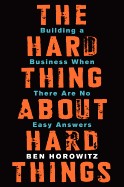
The Hard Thing About Hard Things by Ben Horowitz book cover

★★★★½4.6/5

The verdict: Honest about the mess of running something, which most business books are not.

🎧 Listen free on Audible
Try Kindle Unlimited
Buy the paperback

⚡ Quick answerThe Hard Thing About Hard Things by Ben Horowitz gets 4.6/5 from me. Honest about the mess of running something, which most business books are not. Anyone carrying the weight of a business who wants honest company rather than tidy theory.

What is The Hard Thing About Hard Things about?

Horowitz, a founder turned venture capitalist, writes candidly about the hardest parts of running a business, the decisions, crises and lonely calls that the usual success stories skip over entirely.

The Hard Thing About Hard Things summary

Horowitz sets out to write the book he wishes he had had: not the tidy success story, but an honest account of the brutal, uncertain parts of running a company that most business books ignore. Drawing on his own turbulent experience building and nearly losing companies, he covers the hard things there is no formula for.

He writes frankly about making decisions with incomplete information, managing your own psychology when everything is falling apart, laying people off and demoting friends, firing executives, and the loneliness of being the one who has to make the final call. He is candid about how close his own companies came to failure, and about the gap between the theory of management and the messy reality. Along the way he shares hard-won lessons on hiring, company culture, and leading through crises, delivered bluntly and without the usual gloss.

It is more memoir and reflection than step-by-step manual, and it is pitched at people running venture-backed companies. But the honesty about the emotional and practical difficulty of leadership is rare and valuable, and it translates to anyone carrying the weight of a business.

Published in 2014 by a prominent founder turned venture capitalist, it became a favourite among entrepreneurs for its unusual candour. It is aimed at people building and running companies who want honesty about how hard it really is.

The one idea worth the price: There are no easy formulas for the hardest calls; the job is to keep making decisions and keep going when there is no clear right answer.

Key ideas and takeaways

  • There is no recipe. The hardest problems have no formula; you decide and live with it.
  • Manage your own head. Leading through crisis means managing your own psychology first.
  • The struggle. Every founder faces the grind where it might all fall apart.
  • Honest leadership. Tell hard truths, make hard calls, and own them.

My honest take

Most business books tell you how it should go. This one tells you how it actually feels when it is going wrong, and that honesty is exactly what makes it valuable. Horowitz does not pretend there is a neat formula for the hardest decisions, because there is not, and saying so plainly is more useful than another tidy framework.

The scale is different for most of us, few readers here are running venture-backed firms on the brink, but the emotional truth carries. The loneliness of the final call, making decisions without enough information, keeping going when it might all collapse: any self-employed person who has lain awake over their business will recognise it. It is oddly reassuring to hear someone successful admit how hard and uncertain it really is. Read it for the honesty and the perspective, not for a checklist.

Because it is drawn from the high-stakes world of funded startups, some of the specifics, firing executives, board battles, will not map onto a solo business. But the underlying message, that leadership is mostly about handling hard things without a map, is universal.

The honest caveat: It is pitched at venture-backed company leaders, so a lot of the specific scenarios will not apply to a solo operator. Read it for the emotional honesty and perspective rather than directly transferable tactics.

Where it falls short

  • Aimed at funded-startup leaders, so many specifics do not fit a one-person business.
  • More candid memoir than practical manual, so those wanting step-by-step guidance will not find it.

How it compares

Good to Great researches what makes companies succeed; The Hard Thing About Hard Things tells you honestly how it feels to run one when it might fail. Read Collins for the patterns and Horowitz for the reality.

Who should read it (and who should skip it)

Anyone carrying the weight of a business who wants honest company rather than tidy theory. Skip it if you want a practical how-to or are very early in your journey.

Best format: Audio or Kindle; it reads like Horowitz talking, which suits listening.

How to actually use it if you are self-employed

  • When facing a hard call with no clear answer, accept there is no formula and decide anyway.
  • Look after your own head; you cannot lead well while running on empty.
  • Tell the hard truths in your business rather than avoiding them.
⚡ The 60-second recap

  • The hardest calls have no formula.
  • Managing your own psychology comes first.
  • Honesty about the struggle is the real value.
A book is a shortcut. A second pair of eyes is faster.

Twenty years self-employed, 500+ people coached. If you want help applying this to your own situation, book a free discovery call.

Book a free discovery call

Frequently asked questions

Is it a how-to book?

Not really. It is a candid memoir and reflection on the hardest parts of leadership, not a step-by-step manual.

Is it only for startup founders?

It is pitched at them, but the honesty about the emotional weight of running a business resonates more widely.

Why is it well regarded?

Because it is unusually honest about failure, difficulty and uncertainty, where most business books only show success.

Will it help a solo business?

Some specifics will not apply, but the perspective and honesty are valuable for anyone carrying a business.

Is it a positive or negative read?

It is honest about how hard things get, but many readers find that reassuring rather than discouraging.

Final verdict

The Hard Thing About Hard Things earns 4.6/5. Honest about the mess of running something, which most business books are not. If it is the stage you are at, the cheapest way in is a free Audible trial or Kindle Unlimited.

Disclosure: Some links in this article are affiliate links. If you buy through them I may earn a small commission, at no extra cost to you. Star ratings are my own editorial scores.
Categories
BOOK REVIEWS

Good to Great Review and Summary

A Good to Great review and summary: Jim Collins on what separates companies that make the leap to greatness from those that never do.

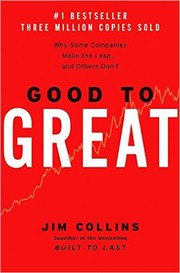
Good to Great by Jim Collins book cover

★★★★½4.5/5

The verdict: Rigorous research on why some companies leap and others just plod.

🎧 Listen free on Audible
Try Kindle Unlimited
Buy the paperback

⚡ Quick answerGood to Great by Jim Collins gets 4.5/5 from me. Rigorous research on why some companies leap and others just plod. Owners of growing businesses, and solo operators who want evidence-based principles to scale by.

What is Good to Great about?

Collins and his research team studied companies that went from merely good to genuinely great and sustained it, comparing them with similar firms that did not, to find the factors that made the difference.

Good to Great summary

Good to Great is built on a large research project: Collins and his team analysed decades of data to identify companies that made a sustained leap from good to great performance, then compared them against similar companies that did not, to isolate what the great ones did differently.

Several findings became famous. Level 5 leadership: the best leaders combined deep personal humility with fierce professional will, the opposite of the ego-driven celebrity chief executive. First who, then what: they got the right people on board before deciding exactly where to go. Confront the brutal facts while keeping faith you will prevail, which he calls the Stockdale Paradox. The Hedgehog Concept: focus relentlessly on the intersection of what you can be best at, what drives your economics, and what you are deeply passionate about. And the flywheel: greatness comes from consistent pushing in one direction that builds momentum, not a single dramatic move.

It is a business-school staple, rigorous and evidence-based, aimed at companies and leaders. Some concepts scale down to a solo business, though the research subjects are large corporations.

Published in 2001, it became one of the best-selling business books of all time and a management-education staple. It is aimed at leaders and companies wanting to understand what drives sustained great performance.

The one idea worth the price: Focus relentlessly on the one thing you can be best at, are passionate about, and can be paid well for. That intersection is your hedgehog.

Key ideas and takeaways

  • Level 5 leadership. The best leaders pair deep humility with fierce will.
  • First who, then what. Get the right people in place before setting the exact direction.
  • The Hedgehog Concept. Focus where your best skill, passion and economics meet.
  • The flywheel. Momentum builds from consistent pushing, not one big move.

My honest take

This is the most research-heavy book in the scaling section, and that rigour is its strength. Rather than one person's opinions, Collins gives you patterns drawn from real data about what separates companies that make the leap from those that stall. Ideas like the Hedgehog Concept and the flywheel have entered the language for good reason.

The honest caveat for this audience is that the research subjects are large corporations, so you have to translate. But the core ideas scale down well. The Hedgehog Concept, focusing where your best skill, your passion and your ability to get paid all overlap, is a genuinely useful prompt for a solo business deciding what to double down on. And Level 5 leadership, humility plus determination, is a healthier model than the ego-driven hustle-guru template. Read it for the principles and apply them at your scale.

Some of the specific companies Collins praised later stumbled, which critics rightly point out and which dents the book's air of certainty. That does not invalidate the patterns, but it is a reminder to treat them as useful ideas rather than guaranteed formulas.

The honest caveat: The research is on big corporations, so a solo operator translates a lot, and some of the celebrated companies later faltered, which undercuts the certainty. Take the concepts as useful patterns, not laws.

Where it falls short

  • Research subjects are large companies, distant from a one-person business.
  • Several praised companies later declined, denting the book's air of certainty.

How it compares

Zero to One argues for building something distinctive; Good to Great researches how the best organisations sustain greatness over time. Read Thiel for the bold start and Collins for the long game.

Who should read it (and who should skip it)

Owners of growing businesses, and solo operators who want evidence-based principles to scale by. Skip it if you want quick tactics rather than researched concepts.

Best format: Kindle or paper, because you will want to note the concepts and revisit them.

How to actually use it if you are self-employed

  • Define your hedgehog: where your best skill, your passion and your income overlap.
  • Focus your effort there and cut what falls outside it.
  • Aim for consistent momentum over one dramatic move.
⚡ The 60-second recap

  • Great leaders pair humility with fierce will.
  • Get the right people, then set direction.
  • Focus on your hedgehog and build the flywheel.
A book is a shortcut. A second pair of eyes is faster.

Twenty years self-employed, 500+ people coached. If you want help applying this to your own situation, book a free discovery call.

Book a free discovery call

Frequently asked questions

What is the Hedgehog Concept?

Focusing on the intersection of what you can be best at, what you are passionate about, and what drives your income.

What is Level 5 leadership?

Collins' term for leaders who combine deep personal humility with fierce professional will.

Is it only for big companies?

The research is on large firms, but concepts like the Hedgehog and flywheel scale down to smaller and solo businesses.

Is the research reliable?

It is rigorous, though some featured companies later declined, so treat the findings as useful patterns rather than guarantees.

Do I need to read Built to Last too?

Not necessarily. Good to Great stands alone; Collins' other books extend the ideas but are not required.

Final verdict

Good to Great earns 4.5/5. Rigorous research on why some companies leap and others just plod. If it is the stage you are at, the cheapest way in is a free Audible trial or Kindle Unlimited.

Disclosure: Some links in this article are affiliate links. If you buy through them I may earn a small commission, at no extra cost to you. Star ratings are my own editorial scores.