

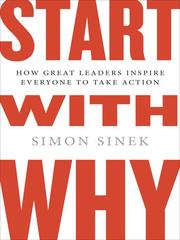
A Start with Why review and summary: Simon Sinek's argument that people buy the reason behind what you do, not just the thing itself.
★★★★½4.5/5
The verdict: A powerful core idea, wrapped in a bit more repetition than it needs.
🎧 Listen free on Audible
Try Kindle Unlimited
Buy the paperback
What is Start with Why about?
Sinek argues that the most influential leaders and businesses think, act and communicate starting from why they do what they do, not what they do. The why is the purpose or belief that inspires people to follow or buy.
Start with Why summary
Sinek builds the book around what he calls the Golden Circle: three rings, with why at the centre, then how, then what on the outside. Most businesses communicate from the outside in, leading with what they do and how they do it. The rare, magnetic ones communicate from the inside out, leading with why they exist and the belief behind the work.
He uses examples, most famously Apple, to argue that people do not buy what you do, they buy why you do it. A clear why attracts customers and staff who share the belief, creates loyalty that price alone cannot, and gives decisions a consistent compass. Without one, a business competes only on features and price, which is a race to the bottom.
The later chapters look at how a why can be discovered, communicated and, crucially, protected as an organisation grows, since Sinek argues many companies lose their way when the what drifts away from the original why.
Published in 2009 and boosted by one of the most-watched TED talks ever, it turned start with why into a business catchphrase. It is aimed at leaders and businesses that want loyalty and meaning rather than competing on price alone.
Key ideas and takeaways
- The Golden Circle. Why at the centre, then how, then what. Start from the middle.
- People buy why. Customers are drawn to the belief behind a product more than its specifications.
- Clarity attracts. A clear why pulls in the right customers and the right people to work with.
- Protect the why. As you grow, keep decisions anchored to the original purpose or you drift.
My honest take
The core idea genuinely holds, and it matters most when your offer looks like everyone else's. When you and three competitors sell roughly the same service at roughly the same price, the why is often the only thing that makes someone choose you.
For the self-employed, this is useful in a very practical way: it shapes how you talk about yourself. Once you can say why you do this work, not just what you do, your marketing stops sounding like a menu and starts sounding like a reason to care.
I will be honest, Sinek stretches one strong idea across a whole book and it can tip into repetition, and the Apple worship gets thick. But the central point is sound and, applied properly, it changes how you position yourself. Take the idea, skim the padding.
Where it falls short
- The single concept is repeated more than it needs to be.
- The examples are cherry-picked survivors, which makes the argument feel neater than reality.
How it compares
Building a StoryBrand is the more practical sibling: where Sinek tells you to find your why, Miller gives you the exact framework to say it. Read Sinek for the concept and StoryBrand for the how.
Who should read it (and who should skip it)
Anyone whose offer blends into the crowd and needs a clearer reason for people to choose them. Skip it if you already have sharp, purpose-led positioning.
How to actually use it if you are self-employed
- Write one sentence explaining why you do your work, beyond making money.
- Rewrite your bio or homepage opener to lead with that why.
- Test it on a few clients and watch which version they respond to.
- Start from why, not what.
- People connect with the belief behind the work.
- Keep growth anchored to your original purpose.
Twenty years self-employed, 500+ people coached. If you want help applying this to your own situation, book a free discovery call.
Frequently asked questions
What is the Golden Circle?
A model with why at the centre, then how, then what. Sinek says the best communicators start from the why.
Is it practical or theoretical?
More conceptual than tactical. It gives you the idea; you supply the application.
Do I need the whole book?
The core lands early. If short on time, the first third gives you the working model.
Is the TED talk enough?
The talk covers the central idea well. The book adds examples and depth, but the essence is in the talk.
Does it apply to a one-person business?
Yes. A clear why is arguably even more powerful when the business is just you.
Final verdict
Start with Why earns 4.5/5. A powerful core idea, wrapped in a bit more repetition than it needs. If it is the stage you are at, the cheapest way in is a free Audible trial or Kindle Unlimited.
Publish reminder: set the featured image and meta description; confirm the /book-reviews/ category is assigned.
Discover more from Alan Spicer - YouTube Certified Expert
Subscribe to get the latest posts sent to your email.


