

A Stolen Focus review and summary: Johann Hari’s argument that our attention problems are bigger than personal failings, and what that means for anyone whose income depends on focus.
Most focus books blame you and hand you a system. Johann Hari blames the world you live in: apps designed to grab attention, poor sleep, constant stress, food and even air quality. It is a bigger, angrier book than most in this section, and it changes how you think about your own distraction.
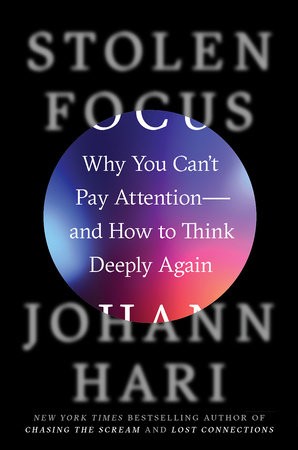
★★★★☆4.1/5
My verdict: A wake-up call about why focus feels harder than ever, stronger on diagnosis than on fixes.
The cheapest way to read it is free: start an Audible trial and use your credit on this one.
Listen free with an Audible trialTry Kindle Unlimited freeSee it on Amazon UK
Best format: Audio. It is a piece of long-form journalism built on interviews and Hari’s own experiment, so it works well as a listen.
Why listen to me? I have been self-employed for 20 years (side hustler, then solopreneur, now business owner), I have coached 500+ creators and business owners, and I get through most of my business reading as audiobooks on dog walks. I review books for one reason: to tell you whether this one earns a place in your week. Read client results.
Jump to:
⚡ QUICK ANSWER: Stolen Focus by Johann Hari gets 4.1/5 from me. It argues that attention problems are driven by twelve forces, from technology designed to distract to stress and poor sleep, so personal willpower is only part of the fix. It suits anyone who wants to understand why focus feels so hard, rather than a list of tips.
What Stolen Focus is about
Johann Hari is a British journalist who has written about addiction and depression. Stolen Focus, published in 2022, started with his own frustration: he felt he could no longer read a book or follow a thought for long, and he wanted to know whether that was his fault or something bigger.
To find out, he spent three months largely offline in Provincetown, Massachusetts, and interviewed researchers around the world. The book is part personal story and part investigation, and its central claim is that our attention has been taken from us by forces we did not choose.
Stolen Focus summary
Hari identifies twelve causes of what he calls an attention crisis. Some are personal habits, such as constant task switching and the collapse of sustained reading. Others are much bigger, including technology built to keep us scrolling, rising stress, poor sleep, worsening diets and even pollution.
His experiment in Provincetown frames the book. Away from his phone and the internet, he found his focus slowly returned, but he is honest that most people cannot run away to the seaside, and that his experience faded once he came home. That is the turning point of his argument: individual fixes help, but they are fighting against systems designed to pull you back.
He spends time on flow states, drawing on Mihaly Csikszentmihalyi’s research, and on the value of letting your mind wander, which he argues is not wasted time but part of how we process ideas. He also covers research on how often people switch tasks at work and how long it takes to get back on track after an interruption.
The final part is a call to action. Hari argues for collective changes, such as limits on surveillance-based business models, a right to disconnect from work and shorter working weeks, alongside the personal steps that help in the meantime.
The one idea worth the price: Your focus problem is partly yours and partly designed. Fix what you can, and stop blaming yourself for the rest.
Key ideas and takeaways
Switching is expensive
Every time you jump between tasks, you pay a cost to get back into the first one. For self-employed people juggling clients, inbox and content, that cost adds up to hours a week.
Flow needs protection
Flow states need a clear goal, the right level of challenge and no interruptions. You rarely stumble into flow with notifications on. You have to set the conditions.
Mind-wandering is not wasted time
Walks, showers and staring out of the window are where a lot of ideas connect. If every gap in your day is filled with a screen, you lose that processing time.
Some of this is bigger than you
Sleep, stress, food and the design of apps all affect attention. Recognising that removes some of the shame and points you towards changes in your environment as well as your willpower.
My honest take
Stolen Focus is the book that made me stop blaming myself for a scattered week and start looking at what was causing it. For a self-employed person whose whole income depends on attention, that shift is useful.
The task-switching section is the one I would underline. When I audit how creators and solo business owners spend their time, the problem is rarely laziness. It is a day chopped into tiny pieces by messages, notifications and context changes. Batching work, as I describe in my guide to batch recording a month of content in one day, is one of the simplest ways to claw that time back.
I also appreciated that Hari does not pretend a digital detox fixes everything. His own focus slipped once he came home, and that honesty makes the book more believable.
Where I part company with him is on how much a reader can do alone. The book is better at explaining the problem than at giving you a Monday-morning plan, so I would pair it with something more practical.
Working all day but your focus is in pieces?
Books compress experience; coaching speeds it up. I have spent 20 years self-employed and coached 500+ people through the same problems this book tackles. A free call is a fast way to turn what you read into a plan for your week.
- You have read the books but nothing has changed yet
- You are working long hours without much to show for it
- You want a second pair of eyes on your business or channel
Where it falls short
The book is much stronger on diagnosis than on solutions. The personal advice is scattered, and the bigger fixes depend on governments and tech companies changing course, which is not much help this week.
Some researchers have pushed back on how strongly Hari reads certain studies, and he occasionally presents debated findings with more certainty than they deserve. Treat the big claims as a starting point rather than settled science.
The honest caveat: If you want a practical system for your own focus, start with Indistractable or Deep Work and read this for the bigger picture.
How it compares
Nir Eyal’s Indistractable is the natural counterpoint, because the two books disagree about where distraction comes from.
| Stolen Focus | Indistractable | |
|---|---|---|
| Where distraction comes from | Systems, design and environment | Inside us, as escape from discomfort |
| Main focus | Diagnosis and collective change | Personal tools and pacts |
| Tone | Investigative and urgent | Practical and forgiving |
| Best for | Understanding the bigger picture | Changing your own habits now |
The truth sits between them. Read Indistractable for what you can control and Stolen Focus for what you cannot, and you will be harder on the system and kinder to yourself.
Who should read it (and who should skip it)
Read it if you feel your attention has got worse over the years and want to understand why, or you like long-form investigative journalism.
Skip it if you want a quick, practical system for focus. The useful personal advice is spread thinly across a long book.
How I would use it if you are self-employed
- I would track how often I switch tasks in a normal morning, just once, to see the real number.
- I would batch similar work (emails, editing, calls) into blocks instead of mixing them across the day.
- I would protect one walk a day without headphones or a phone, to give my mind room to wander.
- I would look at sleep before buying another productivity tool, because tired attention is weak attention.
People also read
If Stolen Focus lands for you, these are the reviews readers open next.
People also ask
What are the 12 causes in Stolen Focus?
Hari lists twelve forces, including faster task switching, the decline of flow, poor sleep, the collapse of sustained reading, less mind-wandering, technology designed to track and manipulate, stress, diet, pollution and the way children’s freedom has shrunk.
Is Stolen Focus worth reading?
Yes, if you want to understand why focus has become harder. It is less useful as a practical guide, so pair it with a book such as Indistractable or Deep Work if you want a system.
Where did Johann Hari go to write Stolen Focus?
He spent three months largely offline in Provincetown, Massachusetts, as an experiment in recovering his attention. That experience frames the book.
Frequently asked questions
What is Stolen Focus about?
It is about why our ability to pay attention seems to be declining. Johann Hari argues that a set of forces, from technology design to stress and sleep, are eroding focus, and that personal willpower is only part of the solution.
Is Stolen Focus scientifically accurate?
It is based on interviews with researchers and published studies, but some experts have questioned how strongly certain findings are presented. It is best read as an investigation that raises good questions rather than a scientific review.
Does Stolen Focus give practical advice?
Some. There are personal changes scattered through the book, such as reducing task switching and protecting time for flow and mind-wandering, but the focus is on diagnosis and wider change.
How does Stolen Focus compare to Deep Work?
Deep Work is a practical guide to building focus in your own working life. Stolen Focus looks outwards at why focus is under attack. Deep Work helps more this week; Stolen Focus explains the background.
Who is Johann Hari?
A British journalist and author. His other books include Chasing the Scream, about addiction, and Lost Connections, about depression. Stolen Focus is his book on attention.
Is Stolen Focus good for people who work from home?
Yes. Home workers are surrounded by the distractions Hari describes, with no office routines to buffer them. The sections on task switching and flow are especially relevant.
Final verdict
Stolen Focus earns 4.1/5 from me. It will not give you a plan for Monday, but it will change how you think about your attention and stop you blaming yourself for everything. Read it alongside a practical focus book for the full picture. The cheapest way in is a free Audible trial (your credit covers this book and it is yours to keep) or a Kindle Unlimited free trial. Prefer paper? Find it on Amazon UK.
About the author: Alan Spicer is a UK-based YouTube Certified Expert (since 2017), self-employed for 20 years, with six YouTube Silver Play Buttons and 500+ creators coached. He has grown channels including Coin Bureau Trading and Woof & Joy, and reviews the books that shaped how he runs a solo business. Fuelled by tea.
Related reading
Want the shortcut from reading to results?
I am a YouTube Certified Expert with 20 years of self-employment behind me, six Silver Play Buttons and 500+ people coached. Bring your goals to a free discovery call and leave with next steps.
Disclosure: some links in this review are affiliate links (Amazon, Audible and Kindle Unlimited). If you sign up or buy through them I may earn a commission at no extra cost to you. Free trial lengths and terms are set by Amazon and Audible, so check current terms before you sign up. Star ratings are my own editorial scores.
