

A practical Atomic Habits review and summary: why James Clear's systems-over-goals approach is the book I hand almost every self-employed client.
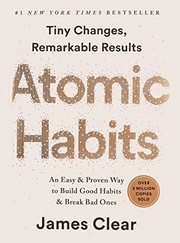
★★★★★4.8/5
The verdict: The most usable habit book there is, and the one I recommend more than any other.
🎧 Listen free on Audible
Try Kindle Unlimited
Buy the paperback
What is Atomic Habits about?
Clear's core claim is that you do not rise to the level of your goals, you fall to the level of your systems. Tiny changes repeated daily compound, and lasting change comes from identity ("I am someone who…") far more than from motivation.
Atomic Habits summary
Clear structures the whole book around a single reframe: stop obsessing over goals and fix your systems instead. Goals set the direction, but your daily systems decide whether you get there. Two people with the same goal succeed or fail on the strength of their systems alone.
The engine of the book is the four laws of behaviour change. To build a habit, make it obvious, make it attractive, make it easy and make it satisfying; to break one, invert each law. Around that he stacks genuinely practical tools: habit stacking, where you attach a new habit to one you already do; environment design, where you arrange your surroundings so the good choice is the easy one; the two-minute rule for getting started; and habit tracking to keep the streak alive.
Underneath the tactics sits the idea that does the heavy lifting: identity. Every action is a vote for the type of person you want to become. You do not try to write a book, you become a writer one small action at a time. Clear ties it together with the plateau of latent potential, the reason habits feel pointless right up until they suddenly pay off.
Published in 2018, it became one of the best-selling non-fiction books of its generation, and for once the sales match the substance. It is written for anyone who knows what they should be doing but cannot get themselves to do it consistently, which describes most self-employed people at some point.
Key ideas and takeaways
- The 1% principle. Small improvements are invisible day to day and enormous over a year. The maths of compounding applies to habits, not just money.
- The four laws. Make it obvious, attractive, easy and satisfying. Flip them to break a bad habit.
- Habit stacking. Bolt a new habit onto one you already do, so an existing routine becomes the trigger.
- Identity over outcomes. You do not chase the goal, you become the kind of person for whom the goal is normal.
My honest take
For the self-employed this might be the most important book on the whole list, because nobody is making you do the work. Motivation is useless on a wet Tuesday when you are your own boss, and Clear's systems survive that exact moment. I have watched clients go from chaotic to consistent on the back of habit-stacking alone, without any grand plan.
It is practical without being preachy and short enough that you will actually finish it, which matters, because a habit book you abandon is its own small irony. This is the one I reach for first when someone tells me they know what to do but cannot make themselves do it.
The reason I recommend it more than any other book here is that you cannot finish it and have nothing to do on Monday. Most self-help leaves you inspired and stuck. This leaves you with two or three specific changes to your actual working day, which for the self-employed is the whole game.
Where it falls short
- If you have read Duhigg or BJ Fogg, some of it will feel like familiar ground in a tidier wrapper.
- It is strong on personal habits and lighter on the messier, people-based habits of running a business.
How it compares
The Slight Edge makes the philosophical case for small actions; Atomic Habits gives you the mechanics to install them. If you only read one, read this, then use The Slight Edge to keep your resolve up on the hard days.
Who should read it (and who should skip it)
Almost everyone, but especially anyone whose problem is consistency rather than knowledge.
How to actually use it if you are self-employed
- Stack one work habit onto something you already do daily, like reviewing your day right after your morning coffee.
- Design your desk so the most important task is the default thing in front of you.
- Write one identity line: I am someone who ships work before checking email.
- Systems beat goals; build the system.
- Use the four laws to design habits on purpose.
- Change the identity and the behaviour follows.
Twenty years self-employed, 500+ people coached. If you want help applying this to your own situation, book a free discovery call.
Frequently asked questions
Is Atomic Habits better than The Power of Habit?
For practical use, most people find it easier to apply. The Power of Habit is stronger on the science and the stories; Atomic Habits is stronger on what to actually do.
How long does it take to read?
A few hours of reading or listening. It is deliberately concise, which is part of why it works.
Does it work for business habits, not just personal ones?
Yes. The systems apply cleanly to sales follow-up, content, admin and anything else you need to do without being told.
Do I need a physical copy?
Only if you want the checklists to hand. The audiobook carries the ideas perfectly well.
Is it worth reading if my habits are already decent?
Yes, because it helps you fix the one or two that keep slipping, which is usually where the money is.
Final verdict
Atomic Habits earns 4.8/5. The most usable habit book there is, and the one I recommend more than any other. If it is the stage you are at, the cheapest way in is a free Audible trial or Kindle Unlimited.
Publish reminder: set the featured image and meta description; confirm the /book-reviews/ category is assigned.
